
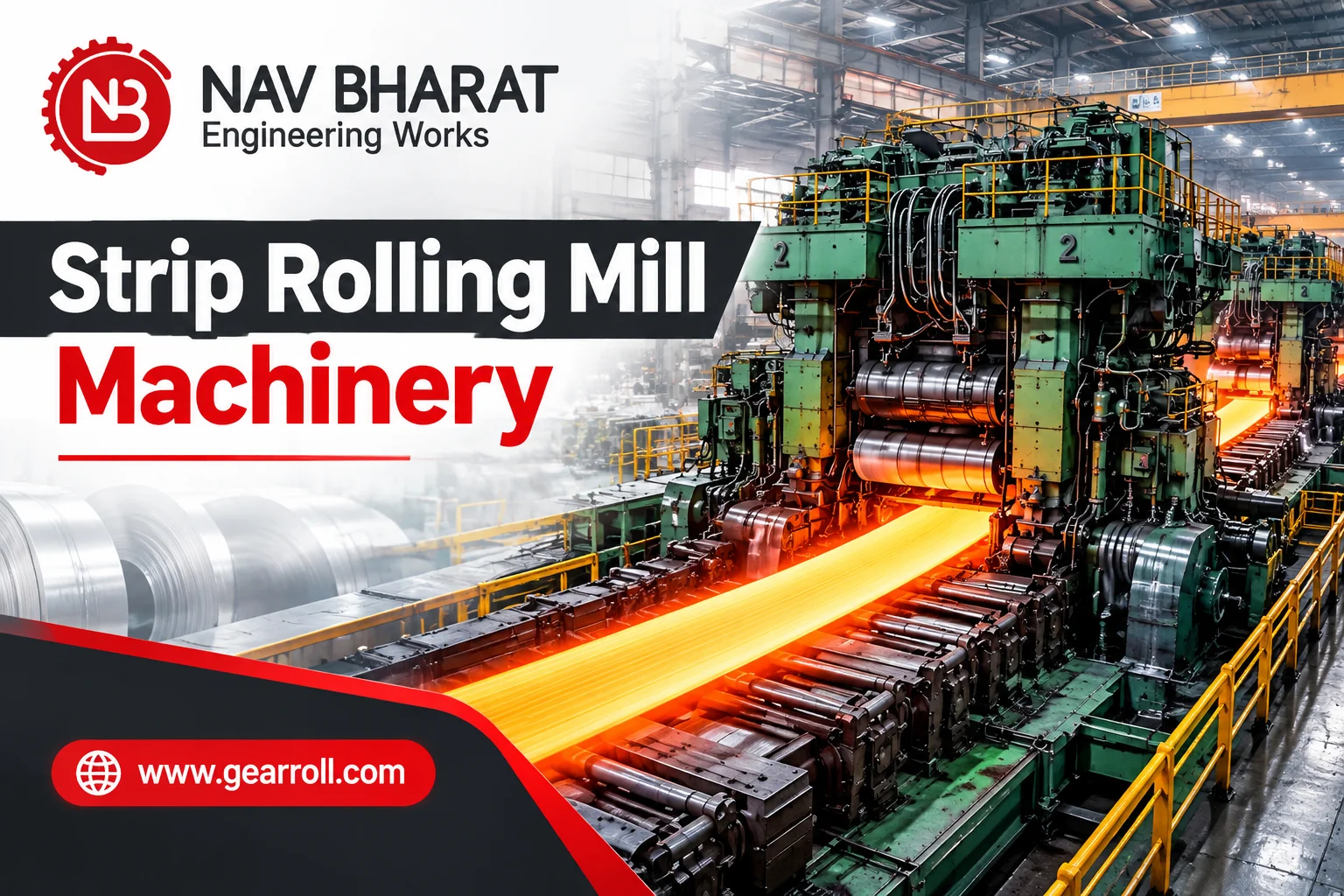
Steel strips are thin, flat strips manufactured with controlled thickness and width. These are used to make automotive parts, structural parts, tubes and pipes, and for other metal processing activities. Their dimensions should be uniform over the entire length of the strip since any variations in width can affect future processes such as manufacturing, cutting, welding, etc. Producing these strips in bulk requires carefully controlled reduction of steel from its initial thickness to the desired strips dimension. Strip rolling mill machinery uses a roughing process followed by the finishing process and controlled cooling and coiling.
What is Strip Rolling Mill
Strip rolling mills are used to reduce the thickness of heated steel and turn it into a continuous strip. This operation consists of a series of stages of reduction or controlled function. The strip rolling mill machinery has a reversing roughing mill, edge equipment, finishing stands, hydraulic gauge control, systems of laminar cooling, and systems for handling coils. Depending on the production needs of the steel plant, these systems can be arranged and designed in different ways.
How Rolling Mills Improve Strip Production
The structure of a rolling mill has a direct influence over the efficiency of moving steel from the primary reduction stage to the finished coil stage. Each of the parts has its own purpose in controlling materials during processing.
Roughing Mills Prepare the Strip
The roughing stage is responsible for the primary reduction of heated steel prior to its entry into the finishing phase. Reverse roughing mills can treat the material through continuous passes, which helps bring it closer to the desired specifications.
Moreover, edging machines are used at this stage to control the strip width during rolling, as it is very important to maintain constant conditions at the entry point and eliminate variations that might affect the operations at the finishing stage.
Finishing Stands Control Dimensions
The finishing phase is intended for strip thinning. The operation uses several finishing stands that perform multiple reductions in several stages. Such a setup is reliable for ensuring the final parameters of the strip throughout a long production process.
Advance Features of Strip Rolling Mills
PLC-Based Process Control
Using PLC-based automation makes it possible to coordinate the rolling line process movement and monitor all conditions systematically. As a result, constant conditions during the production process become feasible, and the number of manual adjustments becomes negligible.
Hydraulic Gauge Control
When producing steel strips in large quantities, thickness control is crucial. By using hydraulic gauge control, it becomes possible to perform the roll gap adjustment process while working on the line.
Laminar Cooling After Finishing
After final processing, the strip is cooled by laminar cooling systems. Controlled cooling allows achieving the needed thermal conditions before the strip enters the coiling process. It also allows coordinating the cooling process with the rolling speed of the strip.
Conclusion
A well-functioning strip rolling mill machinery configuration combines these functions based on the manufacturer’s production needs. Designing an efficient rolling line ensures that steel companies can produce steel strip products effectively and at the expected quality level they require from the finished products. We at Nav Bharat Engineering Works provide strip rolling mills in wide capacities, along with commissioning and excellent after-sales support.
FAQs
Our strip rolling mill features laminar cooling, quick roll changing and advanced coil handling.
Yes, our strip rolling machines are based on PLC-controlled automation.
The strip rolling mills have the capability to work with thicknesses of 1.5-8 mm and strip widths of 150-350 mm.
Our mill uses 6-7 continuous 4-Hi finishing stands for progressive reduction.
The mills supports high-productivity operations with maximum speed up to 90 m/s.
