
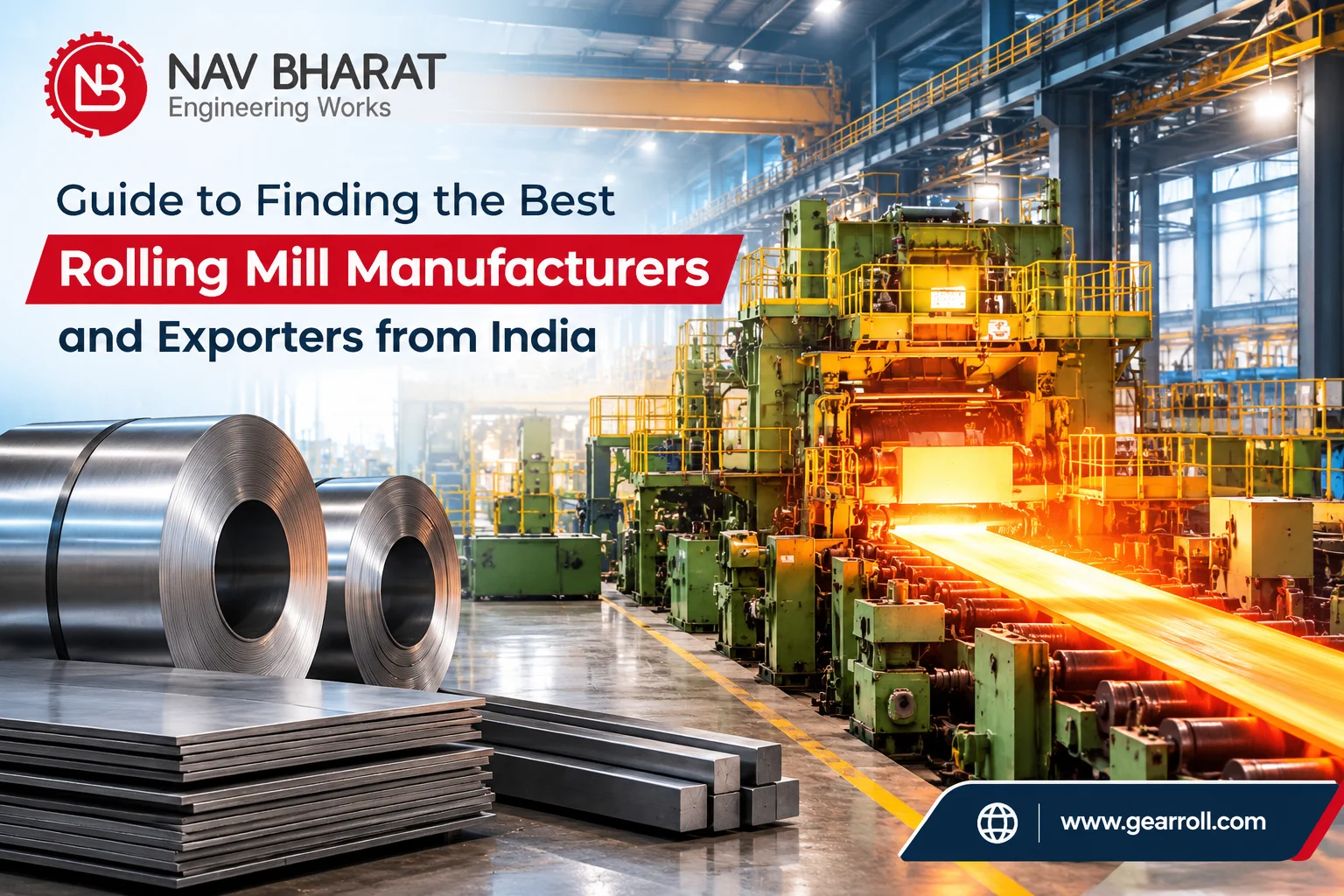
Rolling mills are used in almost every modern metal processing industry. Metals require proper processing, shaping, and refining to give them proper dimensions. That is when the need for a rolling mill arises, as it is helpful in transforming different types of metals into bars, strips, and metal sheets. With the continuous increase in their demand, industries have started searching for reliable rolling mill manufacturers and exporters from India. However, finding a trusted one seems difficult, especially with multiple manufacturers claiming to be the best to gain a position in the export market.
Ensure that you consider factors like mill design, roll configuration, drive systems, material handling equipment, cooling arrangements, automation, and manufacturing accuracy to invest in the right rolling mill. It is advised to go for a reputed and ISO 9001-certified manufacturer. In this blog, we are sharing a complete guide to help you find the best rolling mill manufacturers in India for both domestic and overseas requirements.
What are Rolling Mills?
A rolling mill is an industrial machine mainly used in metal processing industries for reducing the thickness or changing the cross-sectional shape of metals by passing them between rotating rolls. The use of rolling mills varies from industry to industry depending on the application for manufacturing products like bars, rods, strips, sheets, angles, channels and other sections.
Depending on the varying requirements, the rolling process can be carried out at different temperatures and through different mill configurations. That is why it is advised to invest in the right rolling mill that matches the required configuration, material being processed, required product dimensions, production capacity and desired finish.
Types of Rolling Mills
Being one of the leading rolling mill exporters in India, we are focused on manufacturing highly functional rolling mills with different configurations to meet different requirements. Some of the most common types of rolling mills include:
- Two-High Rolling Mill
- Three-High Rolling Mill
- Four-High Rolling Mill
- Cluster Rolling Mill
- Continuous or Tandem Mill
- Planetary Rolling Mill
For those who are unaware of the types of rolling mills, they must seek help from top rolling mill manufacturers in India like Nav Bharat Engineering Works. We have reliable experts to assist you with the same, along with customizing rolling mills by understanding specific requirements.
How Does a Rolling Mill Work?
Rolling mills are used for transforming, shaping, and providing the required finish and dimensions to different types of metals according to industrial needs. In a basic rolling mill process, metals are placed between rotating rolls that apply pressure to reduce sheet thickness and modify them to meet requirements. They work based on 4 main core working principles, including:
- Feeding – Raw material is fed into the gap between 2 heavy, cylindrical steel rollers.
- Compression – Rollers compress the metal sheet by crushing and grinding it under heavy pressure.
- Shearing – Of the two parallel rollers, one roller has grooves or rolls faster, which helps in cutting or trimming.
- Adjustment – Rolling mills are integrated with a control mechanism to operate them according to the width, shape, or size required.
Some metals undergo multi-pass rolling where the metals pass through several rolling stages until the final result is achieved.
Key Factors to Consider When Choosing the Best Rolling Mill Manufacturers
When planning to buy high-quality rolling mills, it is always advised to buy from reliable manufacturers. Below, we are sharing all the required factors that will help you find a trusted rolling mill manufacturer from India. The factors include:
- Overall Manufacturing Experience – When investing in rolling mills, it is advised to check the total experience to know if they are capable of meeting your requirements.
- Check Manufacturing and Designing Capability – The manufacturer should be able to design and manufacture the mill configuration according to the required product, capacity, material, and operating conditions.
- Certifications and Test Documentation – Ensure that the manufacturer holds all the required certifications and documentation that are required for manufacturing high-quality and precise functioning rolling mills. Some of the certifications to look for are ISO 9001:2015, ISO 14001:2015, BIS – IS 6458:1972, CE, and a few more related to safety, material, and quality management. For those dealing in the export of rolling mills, certifications relevant to that country and export documentation are also required.
- Manufacturing Infrastructure – Their manufacturing facility must be equipped with advanced machining, fabrication, assembly, and inspection facilities that are important for producing large and precision-dependent rolling mill equipment consistently.
- Product Range – We already stated above that one rolling mill is not alone suitable for several requirements. So ensure that they design different rolling mill configurations and associated equipment to provide a more suitable solution for different production requirements.
- Consider Energy Consumption – Energy costs can have a substantial effect on the operating cost of a rolling mill. When comparing suppliers, ask about the drive system, motor requirements, and expected energy consumption. Instead of comparing only the purchase price, consider the long-term operating cost of the proposed equipment. A technically suitable system with efficient operation may provide better value over its working life.
- Customization – Rolling requirements vary from industry to industry, and that is when the need for customization arises. It is one of the major reasons why it is advised to choose one of the reliable rolling mill manufacturers and exporters in India who are capable of modifying equipment according to product dimensions, production capacity, available space, and other project specifications.
- Quality Control – Quality cannot be compromised when investing in rolling mills, and that is why ensuring quality control from the beginning is essential. Brands must integrate quality control checks for raw materials, machined components, production process, and at the final stage as well. They must also offer the required quality testing documentation for the same.
- Installation and Commissioning Support – Proper installation, alignment, and commissioning are important for getting the equipment into production as intended. It is advised to clarify what technical assistance the manufacturer provides. Also enquire whether they provide a warranty on rolling mills.
- Check Maintenance Requirements – Maintenance should be discussed before purchasing the equipment. Ask which components require regular inspection, lubrication, replacement, or adjustment. A manufacturer should ideally provide maintenance recommendations and relevant technical support.
- Spare Parts and After-Sales Service – Availability of replacement components and technical support can help reduce avoidable downtime during the equipment’s operating life. The availability of commonly required spare parts is highly important, and a delay in obtaining a critical component can result in unnecessary production downtime. So check beforehand whether the manufacturer supplies all essential spare parts and repair support.
- Export Experience – For international buyers, experience with heavy machinery exports, packaging, documentation, transportation and overseas commissioning is highly essential. Understand that the export of rolling mills requires certain documentation and approvals, so exporters must comply with them.
Common Mistakes to Avoid When Choosing Rolling Mills
A rolling mill is a major industrial investment, so small mistakes at the purchasing stage can create problems during installation and production. Here we are sharing some of the common mistakes that you must avoid when investing in rolling mills:
- Choosing on Price Alone – Buyers often tend to choose rolling mills with the lowest quotation without realizing that a low price may not provide the best overall value. Always consider equipment quality, production capacity, maintenance requirements, energy consumption and after-sales support to choose the best.
- Not Defining Production Requirements Clearly – Manufacturers need accurate information about raw material, input dimensions, finished product, required output, and operating conditions. Incomplete information can result in choosing a rolling mill that does not match the actual production need.
- Selecting the Wrong Mill Configuration – Buyers are often unaware of the mill configuration required and consider same rolling mill for different applications. Ensure that the configuration is based on the product and process rather than simply the manufacturer’s available catalogue.
- Overlooking Customization Requirements – Standard rolling mill machinery may not always fit an existing plant or a specialized production process. It is advised to discuss customization at the design stage to prevent costly modifications later.
- Not Checking Testing and Quality Documents – Buyers should clarify which inspections, material certificates, and testing reports will be provided with the equipment and whether they meet the agreed project specifications.
- Not Considering Future Production Needs – If production capacity is expected to increase, this should be discussed during the initial design stage. Planning for future expansion can be more practical than making major changes after installation.
Quality Certifications and Testing Documentation Required For Rolling Mills Manufacturing
Quality certifications are a must when manufacturing heavy-duty industrial equipment like rolling mills. They operate under continuous mechanical loads, and that is why buyers need confidence that the materials, components, and finished equipment meet the agreed technical specifications. The presence of all the quality certifications and documentation gives a sense of surety to clients. Some of the most common certifications that are a must for rolling mills manufacturing and export include:
- ISO 9001: 2015
- ISO 45001: 2018
- ISO 14001: 2026
- CE Marking
- EU Declaration of Conformity
- BIS Certification
- Material Test Certificates (MTC)
- Factory Acceptance Test (FAT)
- Calibration Certificates
- Performance Test Reports
- Inspection and Quality Reports
As one of the leading rolling mill manufacturers and exporters, we meet all these quality certification requirements successfully. We also offer test documentation for all the tests that we conduct at our manufacturing facility, including material testing, component testing, production process testing, performance testing, and more.
What Makes Nav Bharat Engineering Works the Best Choice?
We at Nav Bharat Engineering Works are one of the ISO, BIS, and CE certified brands offering excellent engineering services for the manufacturing of rolling mill machinery and equipment for the steel and metal-processing industry. Being known for working in this industry since 1985, we have successfully set up an advanced design unit along with highly technical CNC facilities and other manufacturing facilities.
We have expanded our business in more than 80+ cities across PAN India and 18+ countries across the globe. Being one of the best rolling mill manufacturers and exporters from India, we offer different rolling mill configurations along with associated equipment and customised solutions for varied production requirements. Our capabilities cover important stages of a rolling mill project, including engineering, design, manufacturing, quality control, and project support. Businesses searching for customized rolling mill solutions should connect with our experts to get reliable rolling mills matching the configuration required by the metal processing plant.
Conclusion
Rolling mills are an important part of steel and metal processing, and their performance depends on the design, quality, and coordination of numerous mechanical and supporting systems. When searching for the best brand among the top rolling mill manufacturers and exporters from India, buyers should look beyond the initial machinery cost. Instead, they must consider manufacturing infrastructure, engineering capability, customization, component quality, testing documentation, installation support, spare parts, after-sales service, and export experience.
At Nav Bharat Engineering Works, we offer rolling mill machinery and associated equipment for industrial applications, with complete focus on engineering, manufacturing and customized requirements. Our capabilities, advancement in technology, years of experience, and continuous support have enabled us to achieve this position in the market.
FAQs
Consider the manufacturer’s engineering experience, manufacturing infrastructure, product range, customization capability, quality-control procedures, testing documentation, installation support, spare-parts availability, and after-sales service.
Depending on the project, important documents may include Material Test Certificates, dimensional inspection reports, component test certificates, inspection records, calibration certificates, and equipment testing or trial-run reports.
Yes, rolling mill equipment can be designed or modified according to factors such as raw material, finished product dimensions, production capacity, plant layout, and specific process requirements.
Testing helps verify that equipment and its components meet the agreed specifications and operate as intended before they are delivered or installed at the customer’s facility.
Yes, Indian engineering manufacturers supply rolling mill machinery and related equipment to customers in international markets. Overseas buyers should check the manufacturer’s export experience, documentation, packaging and technical support capabilities.
Export documentation depends on the destination and project. Indian exporters generally require an applicable IEC from DGFT, while machinery exports may also require commercial invoices, packing lists, shipping documents, technical documentation, and destination-specific conformity documents.
The choice depends on the raw material, input dimensions, finished product, required production capacity, rolling temperature, reduction requirements and available plant space. These details should be discussed with the manufacturer before finalizing the mill configuration.
